 Risk Posture Tools
The NIST Risk Management Framework has a reputation problem. To practitioners who encounter it through a stack of documentation requirements, it can feel like compliance theater, a process designed to produce artifacts rather than security. That perception is understandable and wrong.
The RMF, defined in NIST SP 800-37 Rev 2, is a decision sequence: a structured set of questions that take a system from "we've deployed this" to "an authorized official has accepted responsibility for its risk." Every step answers a specific question, builds on the previous answer, and feeds the next. Once you see the questions, the artifacts write themselves.
The Core Idea: Linking Security to Mission Risk
Before diving into the steps, it's worth internalizing the framework's purpose. The RMF isn't trying to make systems perfectly secure. It's trying to ensure that the right person, an Authorizing Official with organizational accountability, has made an informed decision about whether a system's residual risk is acceptable for its mission.
Every step either gathers information needed to make that decision, or produces a document that records it. Seen this way, the "bureaucracy" is actually evidence collection for a risk-acceptance judgment.
Step 1, Prepare: Establish Context Before You Start
Prepare is the newest step (added in SP 800-37 Rev 2) and the most commonly skipped. It operates at two levels. At the organizational level, it asks leadership to define risk tolerance, establish common control programs, and assign security roles before any individual system assessment begins. At the system level, it asks: who owns this system, what is its authorization boundary, and which common controls will it inherit?
Why it matters: Every assessment that skips Prepare wastes time re-discovering information that should already be centrally documented. It also produces inconsistent risk tolerance decisions across systems, because no one set the organizational standard that individual system decisions should flow from.
Step 2, Categorize: What's the Impact If This System Fails?
Categorization asks: if the Confidentiality, Integrity, or Availability of this system's information is compromised, what's the impact on the organization's mission? FIPS 199 provides the standard (Low, Moderate, High for each dimension), and SP 800-60 (Volume I is the guide, Volume II the catalog of information types) maps specific information types to provisional impact levels to give teams a starting point.
The output, a system impact level of Low, Moderate, or High derived from the high-water mark of all three CIA dimensions, drives everything that follows. Get this wrong and you'll either over-control a low-risk system or under-control a high-risk one.
Step 3, Select: Choose and Tailor Your Control Baseline
SP 800-53B provides three pre-built control baselines: Low, Moderate, and High, each containing a specific set of security and privacy controls from SP 800-53 Rev 5. Your system's impact level from Step 2 determines which baseline you start with.
But the baseline is a starting point, not the final answer. Tailoring allows you to add controls via overlays (Privacy, CUI, cloud-specific), exclude controls with documented justification, assign organization-defined parameter values, and designate which controls are common (inherited), hybrid (shared), or system-specific. A separate post in this series covers tailoring in depth, but the key principle is that every tailoring decision requires a documented rationale, not just a checkbox.
Step 4, Implement: Make Controls Real
Implementation is the work, not the documentation. For each control in the tailored baseline, someone has to configure a system, write a policy, establish a procedure, or deploy a tool. The System Security Plan is the primary implementation document: it describes, control by control, how each requirement is met, who's responsible, and what the system-specific implementation looks like.
Step 5, Assess: Independent Verification
The Security Assessment (governed by SP 800-53A) asks an independent assessor to determine whether controls are implemented correctly, operating as intended, and producing the desired outcomes. Assessors use three methods: examine (review documents and configurations), interview (talk to personnel), and test (exercise the control). Assessment findings produce the Security Assessment Report; the findings that aren't accepted as residual risk, and so require remediation, seed the POA&M. Findings the AO formally accepts as risk do not.
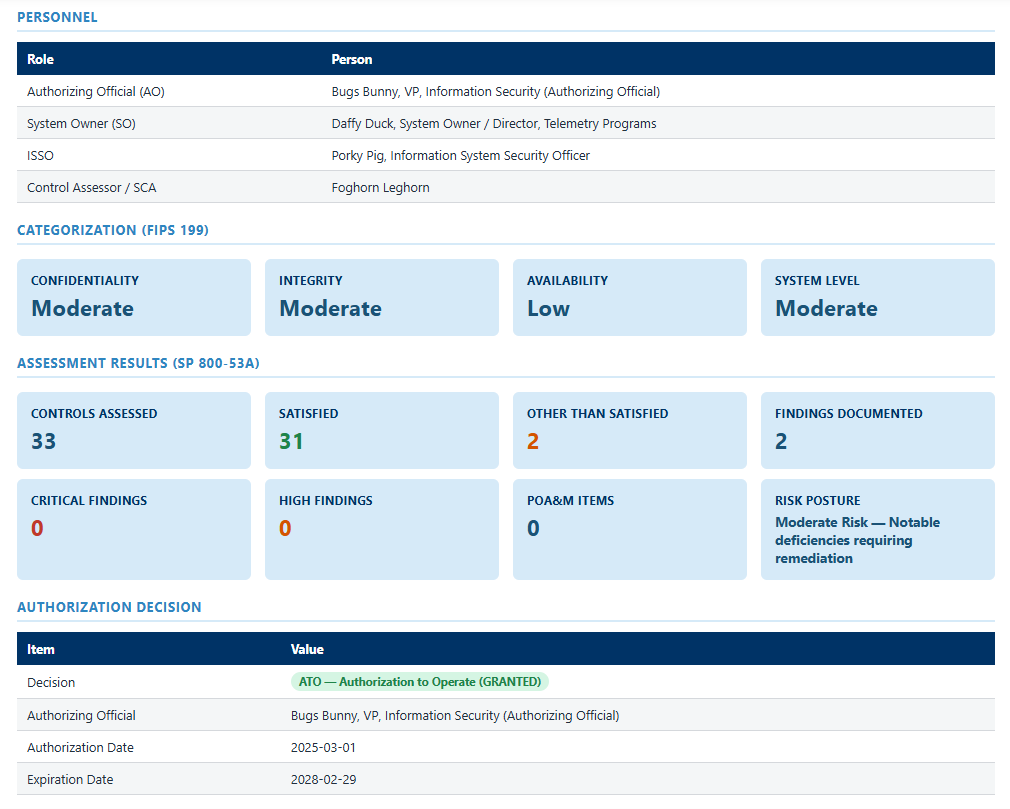
A clean SAR is never the goal, an accurate one is. Findings that are real should be documented and remediated, not minimized. The AO's authorization decision is only as sound as the honesty of the findings underneath it.
Step 6, Authorize: The Decision
Authorization is where an Authorizing Official reviews the complete package, SSP, SAR, POA&M, and makes a formal risk acceptance decision. The possible outcomes:
- ATO (Authority to Operate): Residual risk is accepted. The system may operate.
- IATT (Interim Authorization to Test): An interim, time-limited authorization to test specific system capabilities in a specified environment (often requiring operational or live data), not an authorization to operate: operational use of the system is not permitted under an IATT. It carries its own conditions and expiration, and is not a shortcut around assessment readiness.
- DATO (Denial of Authorization to Operate): Risk is not acceptable. System may not operate.
An ATO carries an expiration and conditions. A three-year cycle is a common convention, rooted in FISMA and OMB guidance, rather than a hard rule in SP 800-37 itself; FedRAMP, DoD, and ongoing-authorization programs set their own reauthorization triggers and assessment cadences. The AO accepts residual risk as documented at the time of authorization, and changes to the system that affect its security posture may trigger reauthorization.
Step 7, Monitor: Keep the Authorization Current
Continuous monitoring keeps the AO informed of changes to the system's security posture between authorization cycles. This means executing the continuous monitoring strategy, tracking POA&M items to closure, assessing the impact of system changes, and keeping the SSP updated to reflect current implementation.
Monitor is where most programs falter after achieving an ATO. The artifacts stop updating, the POA&M stops getting worked, and by the time reauthorization arrives, the SSP no longer reflects reality. Continuous monitoring done right is a manageable cadence, not a perpetual audit.
Walking the Full RMF in the Tool
The NIST RMF Assessment tool structures all seven steps in sequence with guided checklists, FIPS 199 categorization tables, control selection and tailoring, findings tracking, and authorization documentation. Each step builds on the previous one's outputs, so the framework's logical flow becomes a workflow rather than a documentation checklist.
Frequently asked questions
What are the seven steps of the NIST Risk Management Framework?
The RMF, defined in NIST SP 800-37 Rev 2, has seven steps: Prepare, Categorize, Select, Implement, Assess, Authorize, and Monitor. Each step answers a specific question, builds on the previous answer, and feeds the next. Steps 1 through 6 build toward a risk-acceptance decision, and Step 7 sustains it.
Is an IATT the same as an ATO?
No. An IATT (Interim Authorization to Test) is an interim, time-limited authorization to test specific system capabilities in a specified environment, often requiring operational or live data. It is not an authorization to operate: operational use of the system is not permitted under an IATT. It carries its own conditions and expiration, and is not a shortcut around assessment readiness.
Is the RMF three-year authorization cycle a hard rule?
No. A three-year cycle is a common convention, rooted in FISMA and OMB guidance, rather than a hard rule in SP 800-37 itself. FedRAMP, DoD, and ongoing-authorization programs set their own reauthorization triggers and assessment cadences. An ATO carries an expiration and conditions, and changes to the system that affect its security posture may trigger reauthorization.
How should I categorize a system under FIPS 199?
Categorization asks what the impact on the organization's mission would be if the Confidentiality, Integrity, or Availability of the system's information were compromised. FIPS 199 provides the standard (Low, Moderate, High for each dimension), and the system impact level is derived from the high-water mark of all three CIA dimensions. Categorization should be forward-looking, based on what the system might handle as the mission evolves, not just a snapshot of the data it handles today.
Related reading
- System Security Plan (SSP) Template: Structure, Sections, and a Free Builder
- SP 800-53 Control Tailoring: A Daunting Task Made Systematic
- NIST SP 800-30 Risk Assessment: A Template and Worked Example
- the free RMF workflow tool
References
- NIST SP 800-37 Rev 2, Risk Management Framework for Information Systems and Organizations (2018). doi.org/10.6028/NIST.SP.800-37r2
- NIST SP 800-53 Rev 5, Security and Privacy Controls for Information Systems and Organizations (2020). doi.org/10.6028/NIST.SP.800-53r5
- NIST SP 800-53A Rev 5, Assessing Security and Privacy Controls (2022). doi.org/10.6028/NIST.SP.800-53Ar5
- NIST SP 800-53B, Control Baselines for Information Systems and Organizations (2020). doi.org/10.6028/NIST.SP.800-53B
- FIPS 199, Standards for Security Categorization (2004). doi.org/10.6028/NIST.FIPS.199
- NIST SP 800-60 Vol. 1 Rev. 1, Guide for Mapping Types of Information and Information Systems to Security Categories (2008). doi.org/10.6028/NIST.SP.800-60v1r1