 Risk Posture Tools
Every security assessment finds findings. That's the point. An assessment that surfaces zero findings is either reviewing a flawlessly implemented system (rare) or it isn't looking hard enough (common). The question isn't whether you'll have findings, it's what you do with them.
The Plan of Action and Milestones is the answer. It transforms assessment findings into managed items: owned, scheduled, and tracked to closure. And in the FISMA and FedRAMP ecosystems, it's the artifact that authorizing officials actually watch to determine whether a system's authorization remains valid between assessment cycles.
What Is a POA&M?
In brief, a Plan of Action and Milestones is a structured register of known security weaknesses, where each finding gets a row and enough detail (owner, corrective action, milestones, dates, status) that a reviewer can tell whether the item is being actively managed. For the full definition and a field-by-field breakdown of the columns, see the fields a compliant POA&M template needs. This article is about what happens after the POA&M is built: tracking remediation so the authorization it supports stays valid.
POA&M requirements come from more than one place. OMB Circular A-130, Appendix II requires federal agencies to maintain POA&Ms as part of their information security programs, and NIST SP 800-37 Rev 2 builds the POA&M into the RMF itself: it is an output of the Assess step and part of the authorization package the AO weighs.
The POA&M Is Not a Spreadsheet You Fill in Once
The most common POA&M failure is treating it as an authorization package artifact rather than a living tracking document. You run an assessment, populate the POA&M with findings, submit the package, receive an ATO, and the spreadsheet sits untouched until the next assessment cycle, two or three years later.
This is an authorization problem disguised as a document management problem. When reauthorization arrives, the AO finds a POA&M where none of the items have closed, milestones are years overdue, and the resources column still says "TBD." The risk that was accepted at authorization time has quietly materialized into unmanaged exposure.
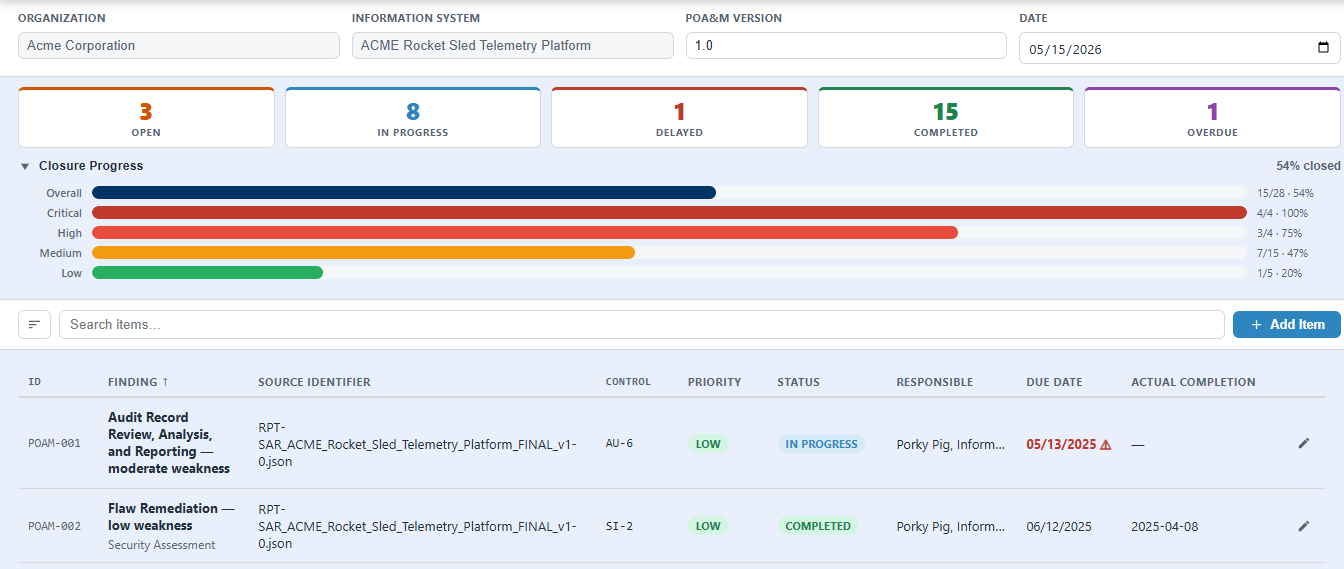
Why Milestones Matter More Than the Due Date
A POA&M item with a single scheduled completion date and no intermediate milestones is untrackable until it's either closed or overdue. There's no signal to detect slip until it's too late.
Breaking remediation into milestones gives you three things: early warning when the first milestone slips, weeks before the final deadline; accountability granularity that makes it clear who is blocking progress; and evidence of active management that an assessor can verify even before the item is closed.
Connecting POA&M Items to the Right Controls
Every POA&M item should reference the SP 800-53 control it implicates. This creates the chain of evidence that makes the authorization package coherent: the SSP describes the control implementation, the SAR documents the finding, and the POA&M tracks the remediation. An auditor or AO should be able to trace a weakness through all three documents using the control identifier as the common thread.
POA&M Hygiene: What to Review Every Month
Good POA&M management is a cadence, not an event. A monthly review should touch five things: overdue items that need either a remediation update or a documented, approved delay; milestone completions to mark in the record; new findings from continuous monitoring or scans that need to be logged immediately; priority escalations for Low findings that have been open for 18+ months; and closures where remediation has been verified and the item can be formally closed with a completion date.
Closed items aren't deleted, they're the evidence trail that the authorization package remains accurate over time.
The POA&M and Your Authorization's Credibility
An AO who signs an ATO accepts risk as documented at authorization. The POA&M represents their expectation that identified gaps will be remediated on the agreed schedule. When items slip without explanation, the risk that was accepted has quietly grown, and the AO was never told. That's a trust problem as much as a compliance one. Authorizing officials who discover a POA&M untouched for 18 months tend to pull authorizations.
Frequently asked questions
How does POA&M remediation tracking keep an ATO valid?
An ATO is a risk acceptance with conditions, not a certificate, and the POA&M is the record that those conditions are being honored. The authorizing official accepted the identified gaps on the expectation that they would be remediated on the agreed schedule. Keeping the POA&M current, closing items on time, and documenting any slip is what proves the accepted risk has not quietly grown between assessment cycles. A POA&M left untouched, with milestones years overdue, tells an AO the opposite, and authorizations get pulled over exactly that.
Is the POA&M just a spreadsheet you fill in once?
No. The most common POA&M failure is treating it as an authorization package artifact rather than a living tracking document, where you populate it with findings, submit the package, receive an ATO, and then leave the spreadsheet untouched until the next assessment cycle. This is an authorization problem disguised as a document management problem: when reauthorization arrives the AO finds items that never closed, milestones years overdue, and risk that has quietly materialized into unmanaged exposure.
What are the FedRAMP POA&M remediation timelines?
FedRAMP cloud service providers submit POA&M updates monthly, and remediation is held to severity-based timelines: High within 30 days, Moderate within 90 days, and Low within 180 days, with Critical findings, where rated, sooner still. These timelines are specific to FedRAMP. Agency FISMA systems set their own remediation cadences, and most review on a quarterly rather than monthly cycle.
Why do POA&M milestones matter more than the due date?
An item with a single scheduled completion date and no intermediate milestones is untrackable until it is either closed or overdue, so there is no signal to detect slip until it is too late. Breaking remediation into milestones gives you early warning when the first milestone slips, accountability granularity that makes it clear who is blocking progress, and evidence of active management that an assessor can verify even before the item is closed.
Related reading
- the fields a compliant POA&M template needs
- RMF Simplified: How the Seven Steps Bring Clarity to System Authorization
- System Security Plan (SSP) Template: Structure, Sections, and a Free Builder
- the free POA&M tracker
References
- OMB Circular A-130, Managing Information as a Strategic Resource, Appendix II (2016). whitehouse.gov
- NIST SP 800-37 Rev 2, Risk Management Framework, Task A-3 and Step 5 (2018). doi.org/10.6028/NIST.SP.800-37r2
- FedRAMP POA&M Template and Guidance. fedramp.gov/documents-templates
- NIST SP 800-53A Rev 5, Assessing Security and Privacy Controls (2022). Assessment procedure outputs (findings → POA&M). doi.org/10.6028/NIST.SP.800-53Ar5